Quantum image processing (QIMP) is using quantum computing or quantum information processing to create and work with quantum images. Due to some of the properties inherent to quantum computation, notably entanglement and parallelism, it is hoped that QIMP technologies will offer capabilities and performances that surpass their traditional equivalents, in terms of computing speed, security, and minimum storage requirements. == Background == A. Y. Vlasov's work in 1997 focused on using a quantum system to recognize orthogonal images. This was followed by efforts using quantum algorithms to search specific patterns in binary images and detect the posture of certain targets. Notably, more optics-based interpretations for quantum imaging were initially experimentally demonstrated in and formalized in after seven years. In 2003, Salvador Venegas-Andraca and S. Bose presented Qubit Lattice, the first published general model for storing, processing and retrieving images using quantum systems. Later on, in 2005, Latorre proposed another kind of representation, called the Real Ket, whose purpose was to encode quantum images as a basis for further applications in QIMP. Furthermore, in 2010 Venegas-Andraca and Ball presented a method for storing and retrieving binary geometrical shapes in quantum mechanical systems in which it is shown that maximally entangled qubits can be used to reconstruct images without using any additional information. Technically, these pioneering efforts with the subsequent studies related to them can be classified into three main groups: Quantum-assisted digital image processing (QDIP): These applications aim at improving digital or classical image processing tasks and applications. Optics-based quantum imaging (OQI) Classically inspired quantum image processing (QIMP) A survey of quantum image representation has been published in. Furthermore, the recently published book Quantum Image Processing provides a comprehensive introduction to quantum image processing, which focuses on extending conventional image processing tasks to the quantum computing frameworks. It summarizes the available quantum image representations and their operations, reviews the possible quantum image applications and their implementation, and discusses the open questions and future development trends. == Quantum image representations == There are various approaches for quantum image representation, that are usually based on the encoding of color information. A common representation is FRQI (Flexible Representation for Quantum Images), that captures the color and position at every pixel of the image, and defined as: | I ⟩ = 1 2 n ∑ i = 0 2 2 n − 1 | c i ⟩ ⊗ | i ⟩ {\displaystyle \vert I\rangle ={\frac {1}{2^{n}}}\sum _{i=0}^{2^{2n-1}}\vert c_{i}\rangle \otimes \vert i\rangle } where | i ⟩ {\textstyle |i\rangle } is the position and | c i ⟩ = c o s θ i | 0 ⟩ + s i n θ i | 1 ⟩ {\textstyle \vert c_{i}\rangle =cos\theta _{i}\vert 0\rangle +sin\theta _{i}\vert 1\rangle } the color with a vector of angles θ i ∈ [ 0 , π / 2 ] {\textstyle \theta _{i}\in \left[0,\pi /2\right]} . As it can be seen, | c i ⟩ {\textstyle \vert c_{i}\rangle } is a regular qubit state of the form | ψ ⟩ = α | 0 ⟩ + β | 1 ⟩ {\displaystyle \vert \psi \rangle =\alpha \vert 0\rangle +\beta \vert 1\rangle } , with basis states | 0 ⟩ = ( 1 0 ) {\textstyle \vert 0\rangle ={\begin{pmatrix}1\\0\end{pmatrix}}} and | 1 ⟩ = ( 0 1 ) {\textstyle \vert 1\rangle ={\begin{pmatrix}0\\1\end{pmatrix}}} , as well as amplitudes α {\textstyle \alpha } and β {\textstyle \beta } that satisfy | α | 2 + | β | 2 = 1 {\textstyle \left|\alpha \right|^{2}+\left|\beta \right|^{2}=1} . Another common representation is MCQI (Multi-Channel Representation for Quantum Images), that uses the RGB channels with quantum states and following FRQI definition: | I ⟩ = 1 2 n + 1 ∑ i = 0 2 2 n − 1 | C R G B i ⟩ ⊗ | i ⟩ {\displaystyle \vert I\rangle ={\frac {1}{2^{n+1}}}\sum _{i=0}^{2^{2n-1}}\vert C_{RGB}^{i}\rangle \otimes \vert i\rangle } | C R G B i ⟩ = cos θ R i | 000 ⟩ + cos θ G i | 001 ⟩ + cos θ B i | 010 ⟩ + sin θ R i | 100 ⟩ + sin θ G i | 101 ⟩ + sin θ B i | 110 ⟩ + cos θ α | 011 ⟩ + sin θ α | 111 ⟩ {\displaystyle {\begin{aligned}{\begin{aligned}\vert C_{RGB}^{i}\rangle &={\cos \theta _{R}^{i}\vert 000\rangle }+{\cos \theta _{G}^{i}\vert 001\rangle }+{\cos \theta _{B}^{i}\vert 010\rangle }\\&\quad +{\sin \theta _{R}^{i}\vert 100\rangle }+{\sin \theta _{G}^{i}\vert 101\rangle }+{\sin \theta _{B}^{i}\vert 110\rangle }\\&\quad +{\cos {\theta _{\alpha }}\vert 011\rangle }+{\sin \theta _{\alpha }\vert 111\rangle }\end{aligned}}\end{aligned}}} Departing from the angle-based approach of FRQI and MCQI, and using a qubit sequence, NEQR (Novel Enhanced Representation for Quantum Images) is another representation approach, that uses a function f ( y , x ) = C y x q − 1 C y x q − 2 … C y x 1 C y x 0 {\textstyle f\left(y,x\right)=C_{yx}^{q-1}C_{yx}^{q-2}\ldots C_{yx}^{1}C_{yx}^{0}} to encode color values for a 2 n × 2 n {\displaystyle 2^{n}\times 2^{n}} image: | I ⟩ = 1 2 n ∑ y = 0 2 n − 1 ∑ x = 0 2 n − 1 | f ( y , x ) ⟩ | y x ⟩ {\displaystyle \vert I\rangle ={\frac {1}{2^{n}}}\sum _{y=0}^{2^{n}-1}\sum _{x=0}^{2^{n}-1}\vert f\left(y,x\right)\rangle \vert yx\rangle } == Quantum image manipulations == A lot of the effort in QIMP has been focused on designing algorithms to manipulate the position and color information encoded using flexible representation of quantum images (FRQI) and its many variants. For instance, FRQI-based fast geometric transformations including (two-point) swapping, flip, (orthogonal) rotations and restricted geometric transformations to constrain these operations to a specified area of an image were initially proposed. Recently, NEQR-based quantum image translation to map the position of each picture element in an input image into a new position in an output image and quantum image scaling to resize a quantum image were discussed. While FRQI-based general form of color transformations were first proposed by means of the single qubit gates such as X, Z, and H gates. Later, Multi-Channel Quantum Image-based channel of interest (CoI) operator to entail shifting the grayscale value of the preselected color channel and the channel swapping (CS) operator to swap the grayscale values between two channels have been fully discussed. To illustrate the feasibility and capability of QIMP algorithms and application, researchers always prefer to simulate the digital image processing tasks on the basis of the QIRs that we already have. By using the basic quantum gates and the aforementioned operations, so far, researchers have contributed to quantum image feature extraction, quantum image segmentation, quantum image morphology, quantum image comparison, quantum image filtering, quantum image classification, quantum image stabilization, among others. In particular, QIMP-based security technologies have attracted extensive interest of researchers as presented in the ensuing discussions. Similarly, these advancements have led to many applications in the areas of watermarking, encryption, and steganography etc., which form the core security technologies highlighted in this area. In general, the work pursued by the researchers in this area are focused on expanding the applicability of QIMP to realize more classical-like digital image processing algorithms; propose technologies to physically realize the QIMP hardware; or simply to note the likely challenges that could impede the realization of some QIMP protocols. == Quantum image transform == By encoding and processing the image information in quantum-mechanical systems, a framework of quantum image processing is presented, where a pure quantum state encodes the image information: to encode the pixel values in the probability amplitudes and the pixel positions in the computational basis states. Given an image F = ( F i , j ) M × L {\displaystyle F=(F_{i,j})_{M\times L}} , where F i , j {\displaystyle F_{i,j}} represents the pixel value at position ( i , j ) {\displaystyle (i,j)} with i = 1 , … , M {\displaystyle i=1,\dots ,M} and j = 1 , … , L {\displaystyle j=1,\dots ,L} , a vector f → {\displaystyle {\vec {f}}} with M L {\displaystyle ML} elements can be formed by letting the first M {\displaystyle M} elements of f → {\displaystyle {\vec {f}}} be the first column of F {\displaystyle F} , the next M {\displaystyle M} elements the second column, etc. A large class of image operations is linear, e.g., unitary transformations, convolutions, and linear filtering. In the quantum computing, the linear transformation can be represented as | g ⟩ = U ^ | f ⟩ {\displaystyle |g\rangle ={\hat {U}}|f\rangle } with the input image state | f ⟩ {\displaystyle |f\rangle } and the output image state | g ⟩ {\displaystyle |g\rangle } . A unitary transformation can be implemented as a unitary evolution. Some basic and commonly used image transforms (e.g., the Fourier, Hadamard, an
Progress in artificial intelligence
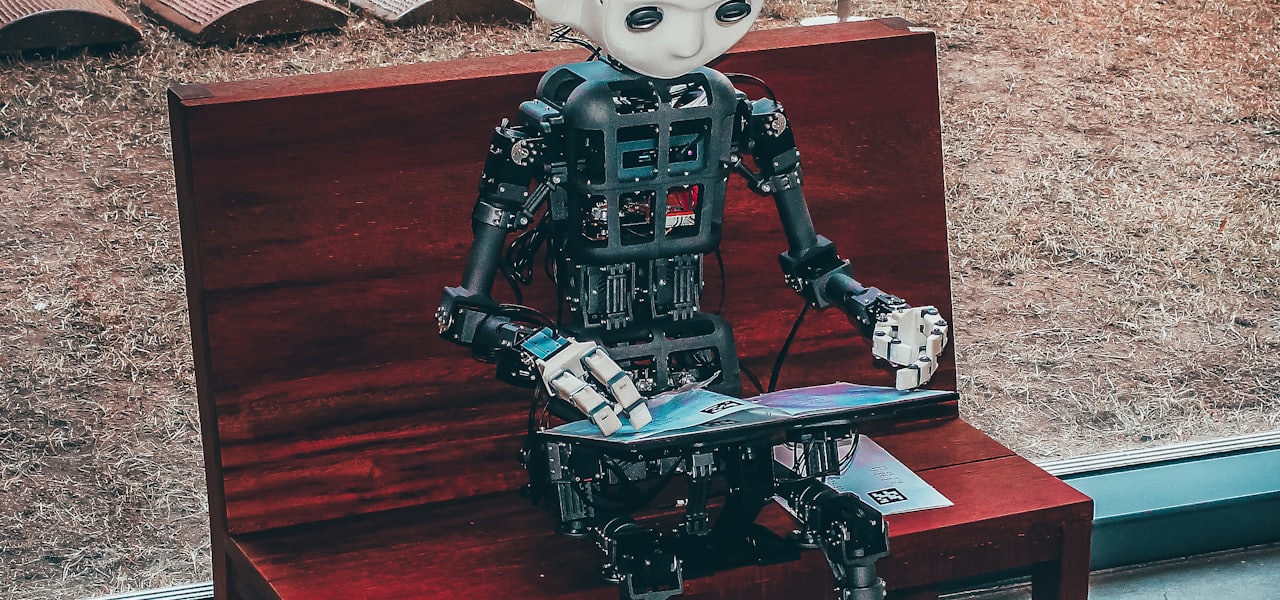
Progress in artificial intelligence (AI) refers to the advances, milestones, and breakthroughs that have been achieved in the field of artificial intelligence over time. AI is a branch of computer science that aims to create machines and systems capable of performing tasks that typically require human intelligence. AI applications have been used in a wide range of fields including medical diagnosis, finance, robotics, law, video games, agriculture, and scientific discovery. The society as a whole is looking for artificial intelligence to be on a key factor in the upcming years because of its potential. However, many AI applications are not perceived as AI: "A lot of cutting-edge AI has filtered into general applications, often without being called AI because once something becomes useful enough and common enough it's not labeled AI anymore." "Many thousands of AI applications are deeply embedded in the infrastructure of every industry." In the late 1990s and early 2000s, AI technology became widely used as elements of larger systems, but the field was rarely credited for these successes at the time. Kaplan and Haenlein structure artificial intelligence along three evolutionary stages: Artificial narrow intelligence – AI capable only of specific tasks; Artificial general intelligence – AI with ability in several areas, and able to autonomously solve problems they were never even designed for; Artificial superintelligence – AI capable of general tasks, including scientific creativity, social skills, and general wisdom. To allow comparison with human performance, artificial intelligence can be evaluated on constrained and well-defined problems. Such tests have been termed subject-matter expert Turing tests. Also, smaller problems provide more achievable goals and there are an ever-increasing number of positive results. In 2023, humans still substantially outperformed both GPT-4 and other models tested on the ConceptARC benchmark. Those models scored 60% on most, and 77% on one category, while humans scored 91% on all and 97% on one category. However, later research in 2025 showed that human-generated output grids were only accurate 73% of the time, while AI models available that year managed to score above 77%. == History == Increasing, promoting or constraining AI progress has often be done via controlling or increasing the amount of compute. == Current performance in specific areas == There are many useful abilities that can be described as showing some form of intelligence. This gives better insight into the comparative success of artificial intelligence in different areas. AI, like electricity or the steam engine, is a general-purpose technology. There is no consensus on how to characterize which tasks AI tends to excel at. Some versions of Moravec's paradox observe that humans are more likely to outperform machines in areas such as physical dexterity that have been the direct target of natural selection. While projects such as AlphaZero have succeeded in generating their own knowledge from scratch, many other machine learning projects require large training datasets. Researcher Andrew Ng has suggested, as a "highly imperfect rule of thumb", that "almost anything a typical human can do with less than one second of mental thought, we can probably now or in the near future automate using AI." Games provide a high-profile benchmark for assessing rates of progress; many games have a large professional player base and a well-established competitive rating system. AlphaGo brought the era of classical board-game benchmarks to a close when Artificial Intelligence proved their competitive edge over humans in 2016. Deep Mind's AlphaGo AI software program defeated the world's best professional Go Player Lee Sedol. Games of imperfect knowledge provide new challenges to AI in the area of game theory; the most prominent milestone in this area was brought to a close by Libratus' poker victory in 2017. E-sports continue to provide additional benchmarks; Facebook AI, Deepmind, and others have engaged with the popular StarCraft franchise of videogames. Broad classes of outcome for an AI test may be given as: optimal: it is not possible to perform better (note: some of these entries were solved by humans) super-human: performs better than all humans high-human: performs better than most humans par-human: performs similarly to most humans sub-human: performs worse than most humans === Optimal === Tic-tac-toe Connect Four: 1988 Checkers (aka 8x8 draughts): Weakly solved (2007) Rubik's Cube: Mostly solved (2010) Heads-up limit hold'em poker: Statistically optimal in the sense that "a human lifetime of play is not sufficient to establish with statistical significance that the strategy is not an exact solution" (2015) === Super-human === Othello (aka reversi): c. 1997 Scrabble: 2006 Backgammon: c. 1995–2002 Chess: Supercomputer (c. 1997); Personal computer (c. 2006); Mobile phone (c. 2009); Computer defeats human + computer (c. 2017) Jeopardy!: Question answering, although the machine did not use speech recognition (2011) Arimaa: 2015 Shogi: c. 2017 Go: 2017 Heads-up no-limit hold'em poker: 2017 Six-player no-limit hold'em poker: 2019 Gran Turismo Sport: 2022 === High-human === Crosswords: c. 2012 Freeciv: 2016 Dota 2: 2018 Bridge card-playing: According to a 2009 review, "the best programs are attaining expert status as (bridge) card players", excluding bidding. StarCraft II: 2019 Mahjong: 2019 Stratego: 2022 No-Press Diplomacy: 2022 Hanabi: 2022 Natural language processing === Par-human === Optical character recognition for ISO 1073-1:1976 and similar special characters. Classification of images Handwriting recognition Facial recognition Visual question answering SQuAD 2.0 English reading-comprehension benchmark (2019) SuperGLUE English-language understanding benchmark (2020) Some school science exams (2019) Some tasks based on Raven's Progressive Matrices Many Atari 2600 games (2015) === Sub-human === Optical character recognition for printed text (nearing par-human for Latin-script typewritten text) Object recognition Various robotics tasks that may require advances in robot hardware as well as AI, including: Stable bipedal locomotion: Bipedal robots can walk, but are less stable than human walkers (as of 2017) Humanoid soccer Speech recognition: "nearly equal to human performance" (2017) Explainability. Current medical systems can diagnose certain medical conditions well, but cannot explain to users why they made the diagnosis. Many tests of fluid intelligence (2020) Bongard visual cognition problems, such as the Bongard-LOGO benchmark (2020) Visual Commonsense Reasoning (VCR) benchmark (as of 2020) Stock market prediction: Financial data collection and processing using Machine Learning algorithms Angry Birds video game, as of 2020 Various tasks that are difficult to solve without contextual knowledge, including: Translation Word-sense disambiguation == Proposed tests of artificial intelligence == In his famous Turing test, Alan Turing picked language, the defining feature of human beings, for its basis. The Turing test is now considered too exploitable to be a meaningful benchmark. The Feigenbaum test, proposed by the inventor of expert systems, tests a machine's knowledge and expertise about a specific subject. A paper by Jim Gray of Microsoft in 2003 suggested extending the Turing test to speech understanding, speaking and recognizing objects and behavior. Proposed "universal intelligence" tests aim to compare how well machines, humans, and even non-human animals perform on problem sets that are generic as possible. At an extreme, the test suite can contain every possible problem, weighted by Kolmogorov complexity; however, these problem sets tend to be dominated by impoverished pattern-matching exercises where a tuned AI can easily exceed human performance levels. == Exams == According to OpenAI, in 2023 GPT-4 achieved high scores on several standardized and professional examinations, including around the 90th percentile on the Uniform Bar Exam, the 89th percentile on the mathematics section of the SAT, the 93rd percentile on SAT Reading and Writing, the 54th percentile on the analytical writing section of the GRE, the 88th percentile on GRE quantitative reasoning, and the 99th percentile on GRE verbal reasoning. OpenAI also reported that GPT-4 scored in the 99th to 100th percentile on the 2020 USA Biology Olympiad semifinal exam and earned top scores on several AP exams. Independent researchers found in 2023 that ChatGPT based on GPT-3.5 performed "at or near the passing threshold" on all three parts of the United States Medical Licensing Examination (USMLE), suggesting that large language models could reach passing-level performance on some medical knowledge assessments even without domain-specific fine-tuning. GPT-3.5 was also reported to attain a low but passing grade on examinations for four law school courses at the University of Minnes
Algorithm
In mathematics and computer science, an algorithm ( ) is a finite sequence of mathematically rigorous instructions, typically used to solve a class of specific problems or to perform a computation. Algorithms are used as specifications for performing calculations and data processing. More advanced algorithms can use conditionals to divert the code execution through various routes (referred to as automated decision-making) and deduce valid inferences (referred to as automated reasoning). In contrast, a heuristic is an approach to solving problems without well-defined correct or optimal results. For example, although social media recommender systems are commonly called "algorithms", they actually rely on heuristics as there is no truly "correct" recommendation. As an effective method, an algorithm can be expressed within a finite amount of space and time and in a well-defined formal language for calculating a function. Starting from an initial state and input, a computation occurs at each step, eventually producing output and terminating. The transition between states can be non-deterministic; randomized algorithms incorporate random input. == Etymology == Around 825 AD, Persian scientist and polymath Muḥammad ibn Mūsā al-Khwārizmī wrote kitāb al-ḥisāb al-hindī ("Book of Indian computation") and kitab al-jam' wa'l-tafriq al-ḥisāb al-hindī ("Addition and subtraction in Indian arithmetic"). In the early 12th century, Latin translations of these texts involving the Hindu–Arabic numeral system and arithmetic appeared, for example Liber Alghoarismi de practica arismetrice, attributed to John of Seville, and Liber Algoritmi de numero Indorum, attributed to Adelard of Bath. Here, alghoarismi or algoritmi is the Latinization of Al-Khwarizmi's name; the text starts with the phrase Dixit Algoritmi, or "Thus spoke Al-Khwarizmi". The word algorism in English came to mean the use of place-value notation in calculations; it occurs in the Ancrene Wisse from circa 1225. By the time Geoffrey Chaucer wrote The Canterbury Tales in the late 14th century, he used a variant of the same word in describing augrym stones, stones used for place-value calculation. In the 15th century, under the influence of the Greek word ἀριθμός (arithmos, "number"; cf. "arithmetic"), the Latin word was altered to algorithmus. By 1596, this form of the word was used in English, as algorithm, by Thomas Hood. == Definition == One informal definition is "a set of rules that precisely defines a sequence of operations", which would include all computer programs, and any bureaucratic procedure or cook-book recipe. In general, a program is an algorithm only if it stops eventually. Formally, algorithm is an explicit set of instructions to produce an output, that can be followed by a computer or a human performing specific operations on symbols.. == History == === Ancient algorithms === Step-by-step procedures for solving mathematical problems have been recorded since antiquity. This includes in Babylonian mathematics (around 2500 BC), Egyptian mathematics (around 1550 BC), Indian mathematics (around 800 BC and later), the Ifa Oracle (around 500 BC), Greek mathematics (around 240 BC), Chinese mathematics (around 200 BC and later), and Arabic mathematics (around 800 AD). The earliest evidence of algorithms is found in ancient Mesopotamian mathematics. A Sumerian clay tablet found in Shuruppak near Baghdad and dated to c. 2500 BC describes the earliest division algorithm. During the Hammurabi dynasty c. 1800 – c. 1600 BC, Babylonian clay tablets described algorithms for computing formulas. Algorithms were also used in Babylonian astronomy. Babylonian clay tablets describe and employ algorithmic procedures to compute the time and place of significant astronomical events. Algorithms for arithmetic are also found in ancient Egyptian mathematics, dating back to the Rhind Mathematical Papyrus c. 1550 BC. Algorithms were later used in ancient Hellenistic mathematics. Two examples are the Sieve of Eratosthenes, which was described in the Introduction to Arithmetic by Nicomachus, and the Euclidean algorithm, which was first described in Euclid's Elements (c. 300 BC).Examples of ancient Indian mathematics included the Shulba Sutras, the Kerala School, and the Brāhmasphuṭasiddhānta. In the 9th century, Muḥammad ibn Mūsā al-Khwārizmī revolutionized the field by establishing the algorithm as a systematic, finite sequence of logical steps to solve mathematical problems. In his influential work, The Compendious Book on Calculation by Completion and Balancing, he moved beyond specific numerical solutions to introduce general procedures for algebraic reduction and balancing. This transformed mathematics into a 'mechanical' process of well-defined rules—a fundamental shift that laid the groundwork for modern algorithmic theory. The Latin translation of his arithmetic treatise, titled Algoritmi de numero Indorum, led to the term algorithm being derived from the Latinization of his name, Algoritmi, specifically to describe this new rule-based approach to mathematics. The first cryptographic algorithm for deciphering encrypted code was developed by Al-Kindi, a 9th-century Arab mathematician, in A Manuscript On Deciphering Cryptographic Messages. He gave the first description of cryptanalysis by frequency analysis, the earliest codebreaking algorithm. === Computers === ==== Weight-driven clocks ==== Weight-driven clocks were a key European invention in Middle Ages, specifically the verge escapement mechanism producing the tick of mechanical clocks. Accurate automatic machines led to mechanical automata in the 13th century and computational machines—the difference and analytical engines of Charles Babbage and Ada Lovelace in the mid-19th century. Lovelace designed the first algorithm intended for a computer, Babbage's analytical engine, the first real Turing-complete computer, more than the mechanical calculators of the time. Although the full implementation of Babbage's second device was only built decades after her lifetime, Lovelace has been called "history's first programmer". ==== Electromechanical relay ==== The Jacquard loom, a precursor to punch cards, and telephone switching machines led to the development of the first computers. By the mid-19th century, the telegraph, was in use throughout the world. By the late 19th century, ticker tape (c. 1870s) and punch cards (c. 1890) were developed. Then came the teleprinter (c. 1910) with its punched-paper use of Baudot code on tape. Telephone-switching networks of electromechanical relays were invented in 1835. These led to the invention of the digital adding device by George Stibitz in 1937. While working in Bell Laboratories, he observed the "burdensome" use of mechanical calculators with gears, prompting him to experiment create an experimental digital adder at home. === Formalization === In 1928, a partial formalization of the modern concept of algorithms began with attempts to solve David Hilbert's Entscheidungsproblem (decision problem). Later formalizations were framed as attempts to define "effective calculability" or "effective method". Those formalizations included the Gödel–Herbrand–Kleene recursive functions of 1930, 1934 and 1935, Alonzo Church's lambda calculus of 1936, Emil Post's Formulation 1 of 1936, and Alan Turing's Turing machines of 1936–37 and 1939. === Modern Algorithms === For decades, it was assumed that algorithm evolution progresses from heuristics to formal algorithms. A Symbolic integration provides a classic illustration. In 1961, James Slagle’s program SAINT used heuristics to solve 52 of 54 freshman calculus exercises from an MIT textbook (≈96%). In 1967, Larry Moses’s SIN refined the heuristics and achieved 100% success, though it remained heuristic. Finally, in 1969, Robert Risch introduced the Risch Algorithm with formal guarantees. This trajectory defined the traditional path: heuristics evolving until a definitive, guaranteed algorithm emerged. However, the rise of transformer-based AI has inverted this sequence — classical algorithms are now being displaced by heuristics once again. Algorithms have evolved and improved in many ways as time goes on. Common uses of algorithms today include social media apps like Instagram and YouTube. Algorithms are used as a way to analyze what people like and push more of those things to the people who interact with them. Quantum computing uses quantum algorithm procedures to solve problems faster. More recently, in 2024, NIST updated their post-quantum encryption standards, which includes new encryption algorithms to enhance defenses against attacks using quantum computing. == Representations == Algorithms can be expressed in many kinds of notation, including natural languages, pseudocode, flowcharts, drakon-charts, programming languages or control tables. Natural language expressions of algorithms tend to be verbose and ambiguous and are rarely used for complex or technical algor
Information Rules
Information Rules is a 1999 book by Carl Shapiro and Hal Varian applying traditional economic theories to modern information-based technologies. The book examines commercial strategies appropriate to companies that deal in information, given the high "first copy" and low "subsequent copy" costs of information commodities, such as music CDs or original texts. == Content == The book examines competing standards, and how a company might influence widespread consumer acceptance of one over another, such as VHS versus Betamax, or HD DVD versus Blu-ray. The book mentions possible business strategies of such publishers as Encyclopædia Britannica who have to confront how to stay viable as technology changes the value and availability of information.
SQL/PSM
SQL/PSM (SQL/Persistent Stored Modules) is an ISO standard mainly defining an extension of SQL with a procedural language for use in stored procedures. Initially published in 1996 as an extension of SQL-92 (ISO/IEC 9075-4:1996, a version sometimes called PSM-96 or even SQL-92/PSM), SQL/PSM was later incorporated into the multi-part SQL:1999 standard, and has been part 4 of that standard since then, most recently in SQL:2023. The SQL:1999 part 4 covered less than the original PSM-96 because the SQL statements for defining, managing, and invoking routines were actually incorporated into part 2 SQL/Foundation, leaving only the procedural language itself as SQL/PSM. The SQL/PSM facilities are still optional as far as the SQL standard is concerned; most of them are grouped in Features P001-P008. SQL/PSM standardizes syntax and semantics for control flow, exception handling (called "condition handling" in SQL/PSM), local variables, assignment of expressions to variables and parameters, and (procedural) use of cursors. It also defines an information schema (metadata) for stored procedures. SQL/PSM is one language in which methods for the SQL:1999 structured types can be defined. The other is Java, via SQL/JRT. SQL/PSM is derived, seemingly directly, from Oracle's PL/SQL. Oracle developed PL/SQL and released it in 1991, basing the language on the US Department of Defense's Ada programming language. However, Oracle has maintained a distance from the standard in its documentation. IBM's SQL PL (used in DB2) and Mimer SQL's PSM were the first two products officially implementing SQL/PSM. It is commonly thought that these two languages, and perhaps also MySQL/MariaDB's procedural language, are closest to the SQL/PSM standard. However, a PostgreSQL addon implements SQL/PSM (alongside its other procedural languages like the PL/SQL-derived plpgsql), although it is not part of the core product. RDF functionality in OpenLink Virtuoso was developed entirely through SQL/PSM, combined with custom datatypes (e.g., ANY for handling URI and Literal relation objects), sophisticated indexing, and flexible physical storage choices (column-wise or row-wise).
Cognition Network Technology
Cognition Network Technology (CNT), also known as Definiens Cognition Network Technology, is an object-based image analysis method developed by Nobel laureate Gerd Binnig together with a team of researchers at Definiens AG in Munich, Germany. It serves for extracting information from images using a hierarchy of image objects (groups of pixels), as opposed to traditional pixel processing methods. To emulate the human mind's cognitive powers, Definiens used patented image segmentation and classification processes, and developed a method to render knowledge in a semantic network. CNT examines pixels not in isolation, but in context. It builds up a picture iteratively, recognizing groups of pixels as objects. It uses the color, shape, texture and size of objects as well as their context and relationships to draw conclusions and inferences, similar to human analysis. == History == In 1994 Professor Gerd Binnig founded Definiens. CNT was first available with the launch of the eCognition software in May 2000. In June 2010, Trimble Navigation Ltd (NASDAQ: TRMB) acquired Definiens business asset in earth sciences markets, including eCognition software, and also licensed Definiens' patented CNT. In 2014, Definiens was acquired by MedImmune, the global biologics research and development arm of AstraZeneca, for an initial consideration of $150 million. == Software == Definiens Tissue Studio Definiens Tissue Studio is a digital pathology image analysis software application based on CNT. The intended use of Definiens Tissue Studio is for biomarker translational research in formalin-fixed, paraffin-embedded tissue samples which have been treated with immunohistochemical staining assays, or hematoxylin and eosin (H&E). The central concept behind Definiens Tissue Studio is a user interface that facilitates machine learning from example digital histopathology images to derive an image analysis solution suitable for the measurement of biomarkers and/or histological features within pre-defined regions of interest on a cell-by-cell basis, and within sub-cellular compartments. The derived image analysis solution is then automatically applied to subsequent digital images to objectively measure defined sets of multiparametric image features. These data sets are used for further understanding the underlying biological processes that drive cancer and other diseases. Image processing and data analysis are performed either on a local desktop computer workstation, or on a server grid. eCognition The eCognition suite offers three components that can be used stand-alone or in combination to solve image analysis tasks. eCognition Developer is a development environment for object-based image analysis. It is used in earth sciences to develop rule sets (or applications) for the analysis of remote sensing data. eCognition Architect enables non-technical users to configure, calibrate and execute image analysis workflows created in eCognition Developer. eCognition Server software provides a processing environment for batch execution of image analysis jobs. eCognition software is utilized in numerous remote sensing and geospatial application scenarios and environments, using a variety of data types: Generic: Rapid Mapping, Change Detection, Object Recognition By environment: Diverse Landcover Mapping, Urban Analysis (i.e. impervious surface area analysis for taxation, property assessment for insurance, inventory of green infrastructure), Forestry (i.e. biomass measurement, species identification, firescar measurement), Agriculture (i.e. regional planning, precision farming, crisis response), Marine and Riparian (i.e. ecosystem evaluation, disaster management, harbor monitoring). Other: Defense, security, atmosphere and climate The online eCognition community was launched in July 2009 and had 2813 members as of July 9, 2010. Membership is distributed globally and user conferences are held regularly, the last having taken place in November 2009 in Munich, Germany. The bi-annual GEOBIA (Geographic Object-Based Image Analysis) conference is heavily attended by eCognition users, with the majority of presentations based on eCognition software.
Information strategist
An information strategist analyses the information flow within an organisation and directs its information resources to better serve the organisation's strategic goals. They work with information technology or within a corporate library to direct high quality information from a variety of sources to users, based upon their profiles and needs. In warfare, information strategists not only seek to improve information flows for their own side but also try to disrupt the information flows of the enemy in order to demoralize and deceive them.